<?xml version="1.0" encoding="utf-8"?><feed xmlns="http://www.w3.org/2005/Atom" xml:lang="en_US"><generator uri="https://jekyllrb.com/" version="3.10.0">Jekyll</generator><link href="https://blog.veraid.org/feed.xml" rel="self" type="application/atom+xml" /><link href="https://blog.veraid.org/" rel="alternate" type="text/html" hreflang="en_US" /><updated>2026-11-02T20:25:51-05:00</updated><id>https://blog.veraid.org/feed.xml</id><title type="html">VeraID Blog</title><subtitle>Safety, identity verification and trust for travelers, providers and businesses in Colombia.</subtitle><author><name>VeraID</name></author><entry><title type="html">Catfish in Online Dating: Verify Before You Meet</title><link href="https://blog.veraid.org/catfish-online-dating/" rel="alternate" type="text/html" title="Catfish in Online Dating: Verify Before You Meet" /><published>2026-11-02T15:00:00-05:00</published><updated>2026-11-02T15:00:00-05:00</updated><id>https://blog.veraid.org/catfish-online-dating</id><content type="html" xml:base="https://blog.veraid.org/catfish-online-dating/"><![CDATA[<div class="vb-takeaways">
  <h2 id="key-takeaways">Key takeaways</h2>

  <ul>
    <li>A catfish in online dating is someone using fake photos, a false name, or a borrowed identity, and a match or a verification badge is not a verification.</li>
    <li>Run a reverse image search on their photos, cross-check small details, and escalate to a short video call before investing emotionally or financially.</li>
    <li>Repeated video call refusals, shifting personal details, and pressure to meet privately or move money are the strongest warning signs.</li>
    <li>In-app verification badges confirm an identity was checked once, not that the person messaging you is that person.</li>
    <li>If you confirm a catfish, stop contact, block and report in-app, and contact your bank immediately if money or documents were shared.</li>
  </ul>
</div>

<p>A catfish in online dating is someone using fake photos, a false name, or a borrowed identity to build a relationship under false pretenses. Before meeting anyone from a dating app in Colombia, run a reverse image search on their photos, ask for a video call with a specific gesture, and check that their story stays consistent across days.</p>

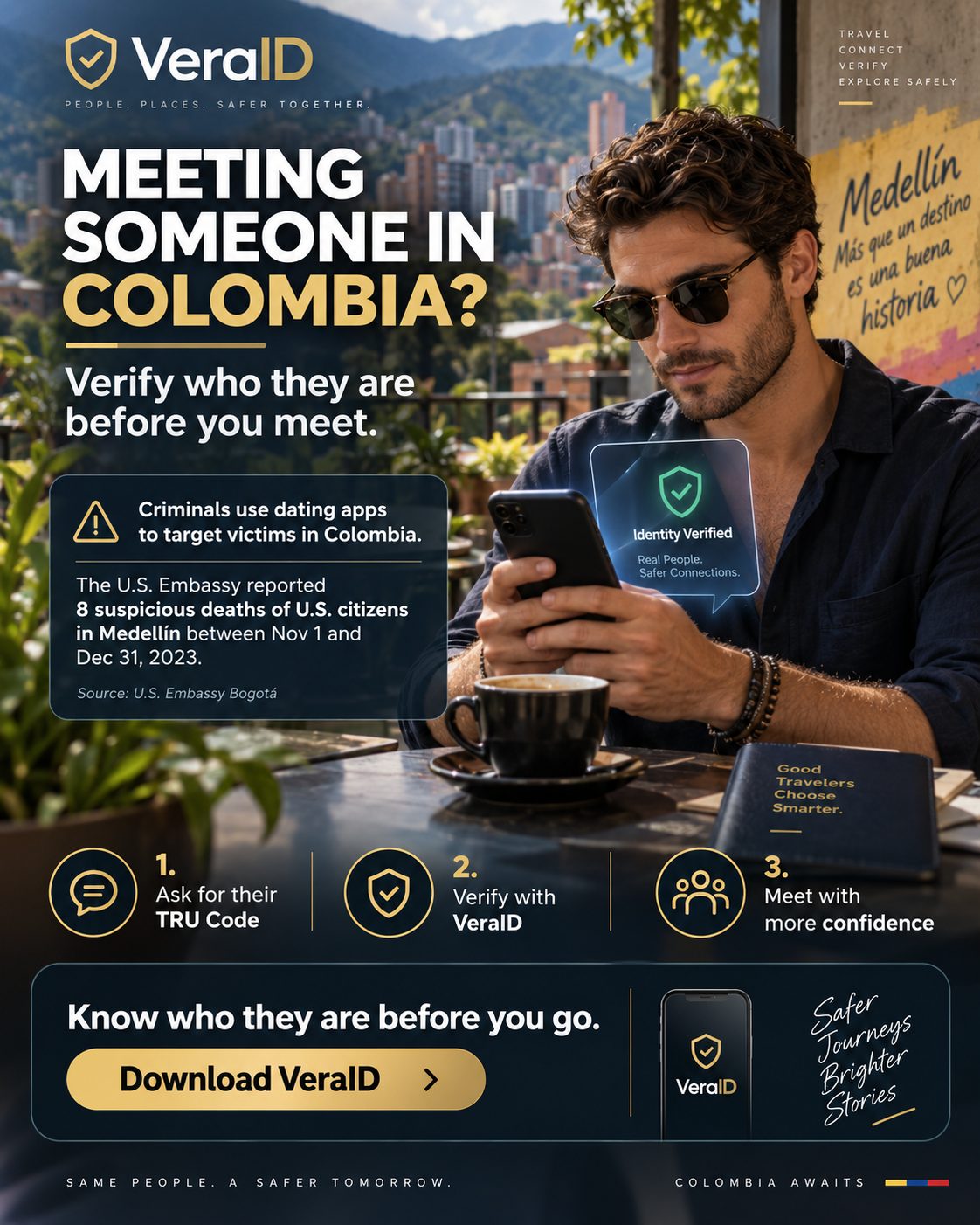
<p><img src="/assets/images/catfish-online-dating.jpg" alt="Meeting someone in Colombia? Verify who they are before you meet. The U.S. Embassy reported 8 suspicious deaths of U.S. citizens in Medellín between Nov 1 and Dec 31, 2023." /></p>

<h2 id="what-is-the-meaning-of-catfish-in-dating">What is the meaning of catfish in dating?</h2>

<p>A catfish in online dating is someone who runs a profile under a false identity: photos, name, and often age belong to another person or are heavily fabricated. The deception can be a stolen influencer’s photos, a friend’s face, or an AI-generated image. The motive ranges from attention to money, and the financial version is common enough that the FTC warns about romance scams where fake partners build trust before asking for cash, gift cards, or crypto.</p>

<p>For travelers in Colombia, the pattern usually looks like this: you match with someone polished, they move the chat to WhatsApp quickly, plans to meet keep slipping, and eventually a problem appears that only money solves. A match is not a verification. Until you have confirmed the person behind the profile is real, you are chatting with a persona.</p>

<h2 id="why-is-it-called-catfishing">Why is it called catfishing?</h2>

<p>The term comes from the 2010 documentary <em>Catfish</em>, which followed Nev Schulman as he built an online relationship with a woman who turned out to be someone else entirely. In the film, her husband tells a story about shipping live catfish with cod so the cod stay active in transit, as a metaphor for people who keep others on their toes. The documentary popularized the word, and in 2014 Merriam-Webster added “catfish” in this sense to its dictionary.</p>

<h2 id="what-are-the-warning-signs-of-a-catfish-in-online-dating">What are the warning signs of a catfish in online dating?</h2>

<p>A catfish rarely trips one wire at a time. The signals arrive in a sequence: vague identity first, resistance to verification second, urgency last. Treat them as a checklist you run in order, not a single alarm bell.</p>

<h3 id="early-signals-in-the-first-few-messages">Early signals in the first few messages</h3>

<p>Watch for a profile with few photos, a job that involves “overseas contracts” or oil rigs, and answers that never match the details in their pictures. If their story shifts between messages, note it and keep checking.</p>

<h3 id="mid-conversation-signals">Mid-conversation signals</h3>

<p>Refusal or repeated failure of a video call is the strongest mid-stage signal. Excuses pile up: broken camera, bad connection, “next week, I promise.” A match is not a verification, and neither is a verified badge they point to instead of showing their face live.</p>

<h3 id="signals-specific-to-meeting-someone-while-traveling">Signals specific to meeting someone while traveling</h3>

<p>Travelers add a layer: pressure to meet quickly at a private location, a driver or tour guide who resists being identified, and requests to move money or buy tickets on their behalf. Sequence your checks before you go.</p>

<div class="vb-table">

  <table>
    <thead>
      <tr>
        <th>Stage</th>
        <th>Signal</th>
        <th>Check to run</th>
      </tr>
    </thead>
    <tbody>
      <tr>
        <td>First messages</td>
        <td>Sparse photos, shifting details</td>
        <td>Reverse image search</td>
      </tr>
      <tr>
        <td>Mid-conversation</td>
        <td>Dodges video calls</td>
        <td>Ask for a 30-second live call</td>
      </tr>
      <tr>
        <td>Pre-meeting</td>
        <td>Private venue pressure, unverified driver</td>
        <td>Verify identity before you meet</td>
      </tr>
    </tbody>
  </table>

</div>

<h2 id="how-do-catfish-dating-pictures-differ-from-real-profile-photos">How do catfish dating pictures differ from real profile photos?</h2>

<p>Catfish dating pictures usually look too good and too few. A real profile shows a range: unflattering angles, bad lighting, group shots, photos with friends or at work. A stolen set tends to be polished, consistent in quality, and cropped so nothing in the background gives away the person’s actual life.</p>

<p>Watch for these visual tells:</p>

<ul>
  <li>Studio-quality or glamour-model shots on an otherwise ordinary profile</li>
  <li>Every photo features the face alone, never full-body or candid</li>
  <li>Inconsistent lighting, skin tone, or hair between pictures, suggesting the set was pulled from more than one source</li>
  <li>Images that look compressed, re-saved, or watermarked, a sign they were lifted from somewhere else</li>
</ul>

<p>The reason is simple: a catfish is assembling a persona, not documenting a life. Real people accumulate awkward, ordinary photos. Stolen ones arrive curated.</p>

<h2 id="how-do-you-catch-a-catfish-in-online-dating-step-by-step">How do you catch a catfish in online dating step by step?</h2>

<p>Catching a catfish is a repeatable process: search their photos, cross-check their details, escalate to video, then verify before you meet. Work through the four steps below in order, and stop escalating the moment something fails.</p>

<h3 id="step-1-reverse-image-search-the-profile-photos">Step 1: Reverse image search the profile photos</h3>

<p>Save two or three of their photos and run them through Google Lens and TinEye. Google Lens works from the app or from Google Search on desktop, where you upload an image and Lens surfaces visually similar pages. A stock photo, a model’s Instagram, or a scam report tied to that face ends the conversation immediately.</p>

<h3 id="step-2-cross-check-the-small-details">Step 2: Cross-check the small details</h3>

<p>Ask questions a real person answers without hesitation: their neighborhood, their job, where they went to school. Then check those answers against their profile, their linked Instagram, and WhatsApp. A match is not a verification, but contradictions are a verdict.</p>

<h3 id="step-3-escalate-to-a-video-call">Step 3: Escalate to a video call</h3>

<p>After a few days of chat, request a short video call. Refusals, broken cameras, and repeated rescheduling are the classic tells. One canceled call is bad luck; three is an answer.</p>

<h3 id="step-4-verify-before-you-meet">Step 4: Verify before you meet</h3>

<p>If you’re traveling, close the loop with a voluntary identity check. Tools in this space split into identity verification like VeraID, panic-button apps like Noonlight and UrSafe, and family trackers like Life360. With VeraID, the person you’re meeting verifies their government ID with a biometric check and gets a permanent TRU ID; you look it up and see their photo and verification status. Its honest limitation: it confirms who that one person is, not anyone else you meet that night. Visitor plans cost $5.99, $14.99 or $19.99. Do the lookup before you leave your accommodation, share the plan with someone back home, and treat a mismatch between the verified photo and the person in front of you as your exit cue.</p>

<h2 id="when-should-you-ask-for-a-video-call-to-verify-identity">When should you ask for a video call to verify identity?</h2>

<p>Ask before emotional or financial investment: after a few days of chatting but before you book the date, send money, or share anything intimate. A match is not a verification, and photos prove nothing. A short video call confirms the person matches their profile, or exposes the gap immediately.</p>

<h3 id="the-escalation-script">The escalation script</h3>

<p>Keep it light and non-accusatory:</p>

<blockquote>
  <p>“I’m having a great time chatting, but I’m visiting and don’t know many people here. Before we meet, would you be up for a quick video call? Just two minutes, so we both know the other one is real.”</p>
</blockquote>

<p>Offer reciprocity: “Happy to do the same on my end.” A real person rarely objects to a two-minute call framed as mutual.</p>

<h3 id="reading-the-response">Reading the response</h3>

<p>One postponement with a concrete reschedule is normal. A pattern is the signal: repeated excuses, a camera that’s “broken,” calls that cut off before their face appears, or anger at a reasonable request. Someone who refuses verification while pushing to meet quickly, move to another platform, or involve money is telling you to stop engaging and walk away.</p>

<h2 id="what-should-you-do-after-confirming-youre-talking-to-a-catfish">What should you do after confirming you’re talking to a catfish?</h2>

<p>Stop contact first, then report. Do not announce that you figured them out; a heads-up just gives them time to delete evidence or reuse your photos for new fake profiles.</p>

<h3 id="if-you-have-not-sent-money-or-documents">If you have not sent money or documents</h3>

<p>Block the account and report it inside the app, then check whether your photos were reused. Run your own pictures through TinEye’s reverse image search to see if they appear on other profiles, and reverse-search the photos they sent you if you have not already. If you connected on WhatsApp or Telegram, report and block there too.</p>

<h3 id="if-you-already-have">If you already have</h3>

<p>If you sent money, contact your bank or card issuer immediately and ask about a fraud claim or recall; speed matters more than certainty. If you shared passport scans, ID photos, or financial details, file a report with the FTC at <a href="https://reportfraud.ftc.gov">ReportFraud.ftc.gov</a> (US) or Action Fraud (UK), and monitor your accounts. If they threaten to release your photos or conversations, do not pay; save the messages as evidence and report the account.</p>

<h2 id="do-free-dating-apps-and-their-verification-badges-protect-you">Do free dating apps and their verification badges protect you?</h2>

<p>A free app’s own verification confirms one narrow thing: the person uploaded a selfie or document at some point. It does not confirm the profile you’re messaging belongs to that verified person, and a match is not a verification. Stolen photos plus a borrowed verified account is a common catfish setup.</p>

<h3 id="what-in-app-badges-actually-confirm">What in-app badges actually confirm</h3>

<p>A badge says the platform checked an identity once. It says nothing about who is typing to you today, whether the photos are current, or whether the account was sold or shared. Treat any badge as a data point, not a conclusion.</p>

<h3 id="where-third-party-verification-fits-and-where-it-falls-short">Where third-party verification fits, and where it falls short</h3>

<p>VeraID lets you check the specific person you’re about to meet, before you go, with visitor plans at $5.99, $14.99 and $19.99. That closes the gap a badge can’t: you confirm the individual behind a permanent TRU ID, not just some account. Its limits are real: it verifies identity at a moment in time, it only works if the other person has registered and verified, and it is voluntary, so a refusal tells you something but the absence of a check tells you less.</p>

<h2 id="faq">FAQ</h2>

<h3 id="do-reverse-image-searches-work-if-the-catfish-uses-ai-generated-photos">Do reverse image searches work if the catfish uses AI-generated photos?</h3>

<p>Partially. AI-generated faces usually return no matches, since the image has never been posted anywhere. That silence is itself a signal: a real person’s photos almost always leave traces. Watch for AI tells like warped ears, teeth, or backgrounds, and lean harder on video calls, which a still image cannot survive.</p>

<h3 id="what-if-they-refuse-a-video-call-but-keep-chatting-warmly">What if they refuse a video call but keep chatting warmly?</h3>

<p>Treat the refusal as the answer. Warmth costs a catfish nothing; a live call exposes them. One postponement with a concrete reschedule is forgivable. A pattern of broken cameras, calls that cut off before their face appears, or anger at a reasonable request means stop engaging and block the account.</p>

<h3 id="is-it-rude-to-ask-someone-to-verify-before-meeting">Is it rude to ask someone to verify before meeting?</h3>

<p>No, if you frame it as mutual. Say you’re visiting and don’t know many people, ask for a two-minute video call, and offer to do the same on your end. A real person rarely objects to reciprocity. Someone pushing to skip checks while rushing to meet is telling you something.</p>

<h3 id="does-a-verification-badge-on-a-dating-app-mean-the-profile-is-safe">Does a verification badge on a dating app mean the profile is safe?</h3>

<p>No. A badge confirms the platform checked an identity once, not that the person messaging you is that person. Stolen photos paired with a borrowed verified account is a common setup. Treat the badge as one data point, then run your own checks: reverse image search, detail cross-checks, and a live video call.</p>]]></content><author><name>VeraID</name></author><summary type="html"><![CDATA[What catfishing is, the warning signs in the order they appear, and a step-by-step process to confirm who you're meeting before a first date in Colombia.]]></summary><media:thumbnail xmlns:media="http://search.yahoo.com/mrss/" url="https://blog.veraid.org/assets/images/catfish-online-dating.jpg" /><media:content medium="image" url="https://blog.veraid.org/assets/images/catfish-online-dating.jpg" xmlns:media="http://search.yahoo.com/mrss/" /></entry><entry><title type="html">Dating App Medellin: Which Apps Work and How to Verify</title><link href="https://blog.veraid.org/dating-app-medellin/" rel="alternate" type="text/html" title="Dating App Medellin: Which Apps Work and How to Verify" /><published>2026-11-02T12:00:00-05:00</published><updated>2026-11-02T12:00:00-05:00</updated><id>https://blog.veraid.org/dating-app-medellin</id><content type="html" xml:base="https://blog.veraid.org/dating-app-medellin/"><![CDATA[<div class="vb-takeaways">
  <h2 id="key-takeaways">Key takeaways</h2>

  <ul>
    <li>Tinder has the deepest user pool in Medellin, with Badoo as a secondary and Bumble strongest among professional locals in El Poblado.</li>
    <li>Spanish-first or bilingual profiles get more matches, especially outside expat-heavy neighborhoods like El Poblado and Laureles.</li>
    <li>Paid tiers buy visibility and filters, not verified identities, so one subscription on a strong local app beats stacking boosts.</li>
    <li>Photo verification badges confirm a face, not intent, so always add a video call, a public venue, and a friend check-in before a first date.</li>
    <li>Matches in Medellin often move to WhatsApp quickly. That’s normal here, but a fast move to WhatsApp combined with money talk is the classic romance scam script.</li>
  </ul>
</div>

<p>Tinder and Badoo dominate Medellin’s dating scene, Bumble is strongest among professionals in El Poblado, and English-only profiles get far fewer matches in Centro and outside the expat-heavy neighborhoods. This guide ranks each app by local user base, pricing, and safety features, then shows how to verify who you’re meeting before you go.</p>

<h2 id="which-dating-apps-have-the-largest-active-user-base-in-medellin">Which dating apps have the largest active user base in Medellin?</h2>

<p>Tinder has the deepest pool of users in Medellin, and it is the app most locals and foreigners both install first. Expect a high match volume in El Poblado and Laureles, but also heavy competition and a large share of profiles built around tourism. If you want volume, start here.</p>

<h3 id="tinder-in-medellin">Tinder in Medellin</h3>

<p>Tinder’s free tier is usable in Colombia, but most of the filtering features sit behind paid tiers priced in local currency on the app itself. Check the current COP pricing in the app or on Tinder’s official site, since prices change by region and platform.</p>

<h3 id="bumble-and-hinge-in-medellin">Bumble and Hinge in Medellin</h3>

<p>Bumble has a solid Medellin base, especially among professional Paisa women, and its women-message-first mechanic filters out some low-effort traffic. Hinge works for longer-form profiles and Spanish practice prompts, but the active user pool is smaller than Tinder’s. English-only profiles do fine on both in tourist-heavy neighborhoods.</p>

<h3 id="badoo-and-regional-apps">Badoo and regional apps</h3>

<p>Badoo remains relevant across Latin America and can surface matches outside the Tinder bubble. Install it as a secondary, not a primary.</p>

<h2 id="do-dating-apps-in-medellin-work-better-for-spanish-speakers-or-english-only-users">Do dating apps in Medellin work better for Spanish speakers or English-only users?</h2>

<p>Spanish profiles get more matches overall, but English-only travelers still get results, especially in El Poblado and Laureles where many locals speak English or want to practice it. A profile written in Spanish signals effort and tends to perform better with users outside the expat-heavy neighborhoods.</p>

<h3 id="profile-language-norms">Profile language norms</h3>

<p>Most Medellin users write profiles in Spanish. English-heavy profiles are common among travelers and are read as short-term visitors, which some locals filter out and others specifically look for. A bilingual profile, Spanish first with a short English line, works for both audiences without much extra work.</p>

<h3 id="translation-workarounds">Translation workarounds</h3>

<p>Google Translate and the built-in translators in apps like Tinder handle most message exchanges well enough for casual conversation. Write your first message in Spanish, even imperfect Spanish, and switch to translation after. If meeting someone matters to you, verify who they are before you go: a match is not a verification, and a verified identity beats a translated one.</p>

<h2 id="what-does-each-major-dating-app-cost-in-colombian-pesos">What does each major dating app cost in Colombian pesos?</h2>

<h3 id="free-vs-paid-tiers">Free vs paid tiers</h3>

<p>Tinder, Bumble, Badoo, and Hinge all run on the same model here: a free tier that works, and paid subscriptions priced in COP when your Google Play or Apple account is set to Colombia. Prices change often with promotions, age brackets, and tier, so check the current price inside each app before you subscribe.</p>

<p>A paid tier is not a verified identity, and none of these apps confirm that a match is who their photos claim.</p>

<h3 id="why-cop-pricing-differs-from-us-pricing">Why COP pricing differs from US pricing</h3>

<p>Apps use regional pricing, so the same subscription often costs less in COP than converting the US dollar price. Set your app store region before subscribing, or you may see USD billing.</p>

<h2 id="which-medellin-dating-sites-are-safest-for-foreigners-to-avoid-romance-scams">Which Medellin dating sites are safest for foreigners to avoid romance scams?</h2>

<h3 id="common-scam-patterns-in-medellin">Common scam patterns in Medellin</h3>

<p>The reported patterns follow a script: a match moves the conversation to WhatsApp quickly, builds rapport over days, then introduces an emergency, an investment pitch, or a request to carry a package. Foreigners matching shortly after landing are prime targets because the timeline compresses.</p>

<h3 id="app-verification-features-compared">App verification features compared</h3>

<p>Tinder and Bumble offer photo verification, which confirms the person in the photos is the person holding the phone. Hinge has a similar selfie check. These are voluntary on every platform, so a verified badge tells you the face is real, not that the intentions are. No app on the market screens for scam behavior at the profile level in a way you can rely on.</p>

<h3 id="where-app-verification-falls-short">Where app verification falls short</h3>

<p>Here is the honest limitation, and it applies to every app in this guide including our own: verification confirms identity, not intent. A scammer can pass a selfie check with their own real face and still run a script on you. A match is not a verification. What verification actually buys you is consistency: the guide at the check-in for your tour, the driver your hotel arranged, and the person you agreed to meet all resolve to the same verified identity.</p>

<p>That is why we built VeraID around voluntary verification before you meet. People on VeraID verify their government ID with a biometric check and get a permanent TRU ID. You ask for their TRU ID, look it up, and see their photo and verification status before you go, with plans starting at $5.99. It does not make anyone safe by itself. It removes the one variable, a fabricated identity, that makes every other scam pattern possible. Pair it with the app-level checks above and your own rules for money and packages, and you have covered what can be covered.</p>

<h2 id="how-do-dating-app-norms-in-medellin-differ-from-us-or-european-markets">How do dating app norms in Medellin differ from US or European markets?</h2>

<p>Expect faster movement off-platform. In Medellin, matches often move to WhatsApp within a few messages, so a match is not a verification of anything. US norms of weeks-long messaging before meeting are uncommon here.</p>

<p>First meets typically happen in public places in El Poblado or Laureles, often daytime coffee or a walk rather than a late-night bar. Don’t feel pressured to cover costs for someone you just met, and be wary of anyone who steers the date toward a venue they pick and you can’t leave easily.</p>

<p>Photo verification norms also differ. Tinder’s Photo Verify feature, described in Tinder’s help center, lets users self-verify with a selfie pose, but adoption is uneven in Medellin, so a verified profile is helpful yet not universal. Treat voluntary verification as a signal, not a guarantee, and verify who you are meeting before you go.</p>

<h2 id="which-apps-are-best-for-meeting-people-in-specific-medellin-neighborhoods-like-el-poblado-or-laureles">Which apps are best for meeting people in specific Medellin neighborhoods like El Poblado or Laureles?</h2>

<h3 id="el-poblado-and-laureles">El Poblado and Laureles</h3>

<p>El Poblado is where traveler-heavy concentration shows up. Tinder and Bumble profiles there skew toward foreigners and English speakers, which makes matching easier for visitors but also attracts the profiles that target tourists. Laureles sits in the middle: more expats and long-stay travelers than Centro, more locals than El Poblado, and a calmer date-night scene around its cafes and parks.</p>

<p>If your goal is meeting people who actually live in the city, Laureles and Envigado tend to surface more local profiles than El Poblado does. Hinge and Bumble generally reward that intent, since their user bases lean toward relationship-minded locals rather than short-term visitor traffic.</p>

<h3 id="centro-and-other-areas">Centro and other areas</h3>

<p>Centro and Comuna 13-adjacent areas see far less dating app activity from either group. Matches thin out, and first-date options are fewer. Practical rule: match by neighborhood, but keep first meetups in public spots in El Poblado or Laureles, and check a verified identity before you go.</p>

<h2 id="are-paid-tiers-on-dating-apps-worth-it-in-medellins-market">Are paid tiers on dating apps worth it in Medellin’s market?</h2>

<p>Paid tiers buy visibility, not judgment. A boost puts your profile in front of more people in El Poblado and Laureles, but it does nothing about whether the person you match with is who their photos claim to be. That second part matters more here: the US Embassy in Colombia has issued <a href="https://www.ktvu.com/news/us-embassy-issues-security-alert-warns-deaths-involving-online-dating-applications-columbia">security alerts warning of deaths linked to online dating apps</a>, and a <a href="https://medellin.co/blog/us-embassy-colombia-straight-talk-crime-alert-medellin-drugging-july-2026">more recent alert about dating-app druggings in Medellín</a>.</p>

<p>If you pay for anything, pay for a monthly subscription on one app with a strong local base rather than stacking boosts across three. Subscriptions unlock filters that narrow matches to people actually nearby, which is worth more than a 30-minute visibility spike.</p>

<p>One honest caveat about our own product: VeraID verifies a person’s identity before you meet, and plans run $5.99, $14.99 and $19.99, but it only works if the person you’re meeting has registered and verified. Voluntary verification is a filter, not a promise.</p>

<h2 id="how-do-you-verify-who-you-are-meeting-before-a-first-date-in-medellin">How do you verify who you are meeting before a first date in Medellin?</h2>

<h3 id="a-pre-date-check-in-routine">A pre-date check-in routine</h3>

<p>A match is not a verification. Before you agree to meet, ask for a video call: it confirms the photos are current and the person matches the profile. Share your plan with someone you trust, including the meeting spot and expected return time. Pick a public venue in a busy area for a first date, and arrange your own transport so you are not dependent on your date for the ride home. Set a check-in with a friend at a fixed time, and keep the first meeting short enough that leaving early feels natural.</p>

<h3 id="what-veraid-does-and-does-not-do">What VeraID does and does not do</h3>

<p>VeraID offers voluntary identity verification. The person you’re meeting verifies their government ID with a biometric check and gets a TRU ID; you look it up before the meet-up and see their photo and verification status. Plans run $5.99, $14.99 and $19.99 USD, and verification is voluntary, so someone refusing it is not proof of anything, only a data point. Where it falls short: VeraID confirms identity at a point in time, not behavior, and it does not replace the check-in routine above. It is one layer alongside video calls, public venues, and reporting if the person who shows up does not match the verified profile.</p>

<h2 id="faq">FAQ</h2>

<h3 id="is-it-safe-to-use-tinder-in-medellin-as-a-solo-traveler">Is it safe to use Tinder in Medellin as a solo traveler?</h3>

<p>Yes, with standard precautions. The US Embassy has issued alerts about crimes against foreigners linked to dating apps, including theft, druggings and worse. Keep conversations on the app at first, be cautious with anyone who moves to WhatsApp immediately and introduces money or packages, and treat a match as unverified until you confirm the person behind it.</p>

<h3 id="do-i-need-a-colombian-phone-number-to-use-dating-apps-in-medellin">Do I need a Colombian phone number to use dating apps in Medellin?</h3>

<p>No. Tinder, Bumble, Badoo, and Hinge all work with your existing number and account. What matters more is your app store region: set Google Play or Apple billing to Colombia before subscribing if you want COP pricing instead of USD. A local SIM helps for logistics like ride apps, but it is not required to match.</p>

<h3 id="how-can-i-tell-if-a-dating-profile-in-medellin-is-fake">How can I tell if a dating profile in Medellin is fake?</h3>

<p>Look for the script: fast movement to WhatsApp, rapport-building over a few days, then an emergency, investment pitch, or package request. Check for photo verification badges on Tinder, Bumble, or Hinge, though these are voluntary. Ask for a video call before meeting; if photos are stale or the person refuses, treat that as a data point.</p>

<h3 id="what-should-i-do-before-meeting-a-match-from-a-dating-app-in-medellin">What should I do before meeting a match from a dating app in Medellin?</h3>

<p>Get on a video call first to confirm the photos are current. Share your plan, meeting spot, and expected return time with someone you trust. Choose a public venue in El Poblado or Laureles, arrange your own transport, and set a fixed check-in with a friend. Identity verification before you go adds one more consistency check.</p>

<h3 id="which-dating-app-do-locals-in-medellin-actually-use-most">Which dating app do locals in Medellin actually use most?</h3>

<p>Tinder has the deepest pool in the city and is the first install for most locals and foreigners. Badoo stays relevant across Latin America and reaches users outside the Tinder bubble, while Bumble has a solid base among professional Paisa women, especially in El Poblado. For meeting people who actually live in Medellin, try Laureles and Envigado.</p>]]></content><author><name>VeraID</name></author><summary type="html"><![CDATA[Which dating apps actually work in Medellín, how profile language and paid tiers affect your matches, and how to verify who you're meeting before a first date.]]></summary><media:thumbnail xmlns:media="http://search.yahoo.com/mrss/" url="https://blog.veraid.org/assets/images/dating-app-medellin.jpg" /><media:content medium="image" url="https://blog.veraid.org/assets/images/dating-app-medellin.jpg" xmlns:media="http://search.yahoo.com/mrss/" /></entry><entry><title type="html">Plenty of Catfish Dating Site: Spot Fake POF Profiles</title><link href="https://blog.veraid.org/spot-fake-pof-profiles/" rel="alternate" type="text/html" title="Plenty of Catfish Dating Site: Spot Fake POF Profiles" /><published>2026-11-02T09:00:00-05:00</published><updated>2026-11-02T09:00:00-05:00</updated><id>https://blog.veraid.org/spot-fake-pof-profiles</id><content type="html" xml:base="https://blog.veraid.org/spot-fake-pof-profiles/"><![CDATA[<div class="vb-takeaways">
  <h2 id="key-takeaways">Key takeaways</h2>

  <ul>
    <li>Check photo count, profile consistency, escalation pace, and money asks before messaging any POF match.</li>
    <li>A verified badge on POF only confirms a selfie match, not the name, age, or intentions behind the account.</li>
    <li>Reverse image search on Google Images or TinEye catches the laziest catfish in under two minutes.</li>
    <li>Any money request, gift card ask, or push to move to WhatsApp marks the line between fake profile and scam.</li>
    <li>With VeraID, you look up a person’s TRU ID before meeting and see their photo and verification status, especially useful when traveling in Colombia.</li>
  </ul>
</div>

<p>You can filter most Plenty of Fish catfish profiles before sending a single message by checking four things: photo count, profile field consistency, escalation pace, and whether the account asks for money or moves the chat off-platform. This guide walks through that checklist step by step, explains why people catfish in the first place, and covers what to do when the signals fall short, especially if you’re using POF while traveling in Colombia.</p>

<h2 id="why-do-people-catfish-on-dating-sites">Why do people catfish on dating sites?</h2>

<p>Catfishing isn’t one behavior with one motive. The fake profile you matched with last night could be a bored teenager, a lonely person hiding behind someone else’s photos, or a professional scammer working a script.</p>

<h3 id="the-four-common-motives-from-boredom-to-money">The four common motives, from boredom to money</h3>

<p>Most catfish fall into four groups. Some want attention or an escape from their own life, using borrowed photos to live out a fantasy. Some are testing boundaries or trolling for reactions. Others run romance scams, building emotional trust over weeks before asking for money, gift cards, or crypto. The last group is the most expensive: the FTC reports that romance scams consistently rank among the costliest fraud categories, with reported losses in the hundreds of millions of dollars every year.</p>

<h3 id="why-travelers-are-targeted-more-than-locals">Why travelers are targeted more than locals</h3>

<p>Travelers make better targets. You’re new to the area, your social circle is thin, and you’re actively looking to meet people. A match who offers to show you around feels like a gift, not a risk. Scammers know this and time their approaches accordingly.</p>

<h2 id="what-are-the-warning-signs-of-a-catfish-profile-on-plenty-of-fish">What are the warning signs of a catfish profile on Plenty of Fish?</h2>

<h3 id="photo-signals-one-photo-studio-quality-no-candid-shots">Photo signals: one photo, studio quality, no candid shots</h3>

<p>A profile built on a single photo is the oldest catfish tell on Plenty of Fish, and it still works because it costs nothing to copy. Studio-quality headshots are the second layer of the same signal: real people’s photo libraries are messy, full of bad lighting, group shots, and pictures taken by friends. A match whose every image looks like a modelling portfolio is showing you a borrowed life.</p>

<h3 id="bio-signals-vague-location-generic-interests-fast-emotional-escalation">Bio signals: vague location, generic interests, fast emotional escalation</h3>

<p>The bio fills in what the photos start. Watch for a location that stays vague or shifts between messages, interests so generic they could describe anyone (travelling, music, gym), and a story that never quite adds up.</p>

<p>The strongest single signal is pace. A real match in Colombia who wants to meet you will ask practical questions: where you’re staying, what neighbourhood, when you’re free. A catfish skips that logistics stage and moves straight to emotional intensity, telling you within a day or two that they’ve never felt this connection, or that they’re falling for you before you’ve video-called. That escalation is deliberate. It builds attachment before you’ve had a chance to test anything, so that when you finally suggest verifying who they are before you meet, you feel like the one being difficult. A match is not a verification, and someone who resents a simple check-in request has told you exactly what you needed to know.</p>

<h2 id="how-can-you-verify-a-pof-profile-is-real-before-messaging">How can you verify a POF profile is real before messaging?</h2>

<p>A match is not a verification. POF gives you a few built-in signals and free external tests that take under ten minutes before you send the first message.</p>

<h3 id="the-7-point-pre-message-checklist">The 7-point pre-message checklist</h3>

<div class="vb-table">

  <table>
    <thead>
      <tr>
        <th>#</th>
        <th>Check</th>
        <th>What “real” looks like</th>
      </tr>
    </thead>
    <tbody>
      <tr>
        <td>1</td>
        <td>Profile photo variety</td>
        <td>Multiple candid shots, not one studio image</td>
      </tr>
      <tr>
        <td>2</td>
        <td>Photo consistency</td>
        <td>Same face across all photos, same era</td>
      </tr>
      <tr>
        <td>3</td>
        <td>Written detail</td>
        <td>Specifics: job, neighbourhood, travel plans</td>
      </tr>
      <tr>
        <td>4</td>
        <td>Conversation coherence</td>
        <td>Replies match stated location and timezone</td>
      </tr>
      <tr>
        <td>5</td>
        <td>Refusal pattern</td>
        <td>No push to move to WhatsApp within two messages</td>
      </tr>
      <tr>
        <td>6</td>
        <td>Money or crypto angle</td>
        <td>Absent entirely</td>
      </tr>
      <tr>
        <td>7</td>
        <td>Voluntary verification</td>
        <td>Verified badge present, or willingness to get one</td>
      </tr>
    </tbody>
  </table>

</div>

<p>Any single miss is noise. Two or more is a pattern.</p>

<h3 id="reverse-image-search-and-video-call-tests-that-cost-nothing">Reverse image search and video-call tests that cost nothing</h3>

<p>Save the profile photo and run it through Google Images or TinEye. A stock photo or a photo tied to a different name ends the conversation. Then ask for a short video call. A catfish almost always has a reason the camera “isn’t working”; a real person just says hello.</p>

<h3 id="when-voluntary-verification-is-the-tiebreaker">When voluntary verification is the tiebreaker</h3>

<p>POF supports voluntary photo verification, and its own help pages explain how the process and reporting work. A verified profile is not a character reference, but when two profiles look equal, the verified one is the lower-risk conversation to open.</p>

<h2 id="how-does-pofs-verification-compare-to-other-dating-apps">How does POF’s verification compare to other dating apps?</h2>

<h3 id="what-pof-verifies-and-what-it-leaves-open">What POF verifies and what it leaves open</h3>

<p>POF offers photo verification, which asks you to submit a selfie matching a posed gesture so your profile can carry a verified marker. That covers one thing: the photos belong to a real person who took them recently. It does not cover name, age accuracy beyond self-reported fields, or whether the person behind the account is who they claim to be offline. Tinder, Bumble, and Hinge each run some version of photo or video selfie verification too, and none of them verify identity in the deeper sense. A verified badge on any of these apps means the profile passed a selfie check, not that the account holder’s stated name, nationality, or job is accurate. If you are screening matches before traveling to Colombia, treat every badge the same way: a weak signal, not a conclusion.</p>

<h3 id="a-match-is-not-a-verification-why-badges-are-not-enough">A match is not a verification: why badges are not enough</h3>

<p>Badges confirm a face, not an intention. A catfish can pass selfie verification with their own face and still misrepresent everything else, or borrow a verified account entirely. That is why voluntary verification tools exist outside the apps: they let people confirm identity directly, before meeting, instead of relying on a platform’s minimum bar.</p>

<p>This is where VeraID fits. People on VeraID verify their government ID with a biometric check and receive a permanent TRU ID. Before you meet, you ask for their TRU ID and look it up in the app, so you see their photo and verification status instead of trusting a badge. Run it through the same honest criteria: VeraID does not know someone’s intentions, it cannot vouch for behavior on a date, and it only works if the other person has registered and verified. What it adds is a step POF cannot provide: confirmation that the person who shows up is the verified person behind the code.</p>

<h2 id="when-does-catfishing-cross-into-a-scam-you-should-report">When does catfishing cross into a scam you should report?</h2>

<p>A fake profile is annoying. A scam is when the person behind it starts moving money out of your pocket. So watch for escalation, not just fakery.</p>

<h3 id="money-requests-off-platform-moves-and-gift-cards">Money requests, off-platform moves, and gift cards</h3>

<p>Three signals mark the line. First, any money request: an emergency, a customs fee, a plane ticket. Second, a push to leave POF for WhatsApp or Telegram before you’ve verified anything, which removes the platform’s reporting tools. Third, gift cards, crypto, or wire transfers, which are the standard payout rails of romance fraud and nearly impossible to reverse.</p>

<h3 id="reporting-a-profile-on-pof-step-by-step">Reporting a profile on POF step by step</h3>

<p>Open the conversation, tap the flag or report icon, choose the reason (scam or fake profile), and add specifics: the money request, the off-platform ask, any links they sent. Then block. If you already sent money, contact your bank immediately and file a report with the FTC at <a href="https://reportfraud.ftc.gov">ReportFraud.ftc.gov</a>. Reporting protects the next traveler, not just you.</p>

<h2 id="what-should-you-do-if-you-match-with-a-catfish-on-pof">What should you do if you match with a catfish on POF?</h2>

<p>Stop messaging first. Don’t confront them or ask for explanations; confrontation just gives a catfish time to change accounts and tactics. Screenshot the profile, photos, and any messages that show deception, then use POF’s report and block tools so the profile is flagged before it reaches anyone else.</p>

<h3 id="cutting-contact-and-reporting">Cutting contact and reporting</h3>

<p>Report through the app, then block. If money changed hands or the person claimed to be a tour guide or driver, keep your screenshots; they matter if you dispute a payment with your bank or card issuer. Don’t re-engage to “get answers.” A verified identity can’t be faked retroactively, and neither can an apology.</p>

<h3 id="if-you-already-shared-photos-money-or-personal-details">If you already shared photos, money, or personal details</h3>

<p>Contact your bank immediately about any transfers, and change passwords if you reused one. If intimate photos were shared, stop contact and report through the platform; don’t pay anyone threatening to release them, because paying rarely ends the demands. Watch your accounts for unusual activity over the following weeks.</p>

<h2 id="how-do-you-verify-someone-before-meeting-them-in-colombia">How do you verify someone before meeting them in Colombia?</h2>

<h3 id="veraid-verify-who-youre-meeting-before-you-meet">VeraID: verify who you’re meeting before you meet</h3>

<p>VeraID visitor plans cost $5.99, $14.99 or $19.99. Guides, drivers, hosts and professionals register on VeraID, verify their government ID with a biometric check, and get a permanent TRU ID. Before the meeting, you ask for their TRU ID and look it up: you see their photo, first name and verification status, not a self-reported name. It fits the “a match is not a verification” rule: the check happens before you’re in the taxi, not during it.</p>

<h3 id="running-veraid-through-the-same-checklist-honestly">Running VeraID through the same checklist honestly</h3>

<p>VeraID only works if the other person has registered and verified, and it confirms identity, not intent. A verified driver is still a stranger; verification is voluntary, so a refusal is a signal but not proof of anything. Treat it as one input alongside video calls and public meeting spots, never as a substitute for them.</p>

<h3 id="alternatives-for-personal-safety-noonlight-ursafe-life360-and-citizen">Alternatives for personal safety: Noonlight, UrSafe, Life360, and Citizen</h3>

<p>Safety apps cover a different gap. Noonlight connects you to responders when you trigger an alarm; UrSafe offers hands-free check-in during dates; Life360 handles location sharing among people you already trust; Citizen focuses on incident alerts and local safety reporting. Pair one with VeraID: identity before you go, backup while you’re there.</p>

<h2 id="what-verification-signals-matter-most-when-youre-traveling">What verification signals matter most when you’re traveling?</h2>

<h3 id="verified-identity-versus-claimed-identity">Verified identity versus claimed identity</h3>

<p>Away from home, a match is not a verification. Treat any claimed name, job, or hotel as unconfirmed until you see a verified identity: a government-ID match, ideally through a service like VeraID, where you check who they are before you go. Ask for it early, not on meetup day.</p>

<h3 id="check-in-habits-and-safety-reporting-before-a-first-meeting">Check-in habits and safety reporting before a first meeting</h3>

<p>A fixed meetup date compresses your timeline, so sequence your checks: verified profile first, then a video call, then a check-in plan with someone back home. Tools like Noonlight, UrSafe, Life360, and Citizen cover the arrival side; VeraID covers the “who am I actually meeting” side. It does not cover everything, and no signal does, but ID verification plus a check-in habit is the strongest pair you can run before a first meeting abroad.</p>

<h2 id="faq">FAQ</h2>

<h3 id="can-you-get-catfished-on-plenty-of-fish-even-if-a-profile-has-a-verified-badge">Can you get catfished on Plenty of Fish even if a profile has a verified badge?</h3>

<p>Yes. POF’s photo verification only confirms the selfie matches the photos on the profile. It says nothing about the name, age, job, or intentions behind the account. A catfish can pass the selfie check with their own face and still misrepresent everything else, or operate a borrowed, already-verified account.</p>

<h3 id="is-plenty-of-fish-worse-for-catfishing-than-other-dating-apps">Is Plenty of Fish worse for catfishing than other dating apps?</h3>

<p>There’s no solid evidence it is. Tinder, Bumble, and Hinge all run some version of photo or selfie verification, and none of them verify identity in a deeper sense either. On any platform, a badge means the profile passed a face check, not that the person is honest. Apply the same screening checklist everywhere.</p>

<h3 id="should-i-send-my-id-to-someone-i-matched-with-to-prove-im-real">Should I send my ID to someone I matched with to prove I’m real?</h3>

<p>No. Sending a photo of your government ID to a stranger hands them material for identity theft and gives you nothing in return. If you want verification, use a service built for it, like VeraID, where your ID is checked through the platform and the other person only sees your photo, first name and verification status, never your document.</p>

<h3 id="how-do-i-reverse-image-search-a-dating-profile-photo-for-free">How do I reverse image search a dating profile photo for free?</h3>

<p>Save the photo to your device, then upload it to Google Images or TinEye, both free. If the image appears on a stock photo site, a modelling portfolio under a different name, or multiple profiles with different names, stop the conversation. It takes under two minutes and catches the laziest catfish immediately.</p>

<h3 id="what-information-should-i-never-share-with-a-pof-match-before-meeting">What information should I never share with a POF match before meeting?</h3>

<p>Never send money, gift cards, or crypto, and never share financial details, passwords, or copies of your ID. Hold back your home address, hotel name, and daily schedule until you’ve verified them through a video call. Also avoid intimate photos: if a scammer gets them, paying a blackmail demand rarely ends the threats.</p>]]></content><author><name>VeraID</name></author><summary type="html"><![CDATA[Check photo count, profile consistency, escalation pace and money asks before you message any POF match, and how to verify who you're meeting in Colombia.]]></summary><media:thumbnail xmlns:media="http://search.yahoo.com/mrss/" url="https://blog.veraid.org/assets/images/spot-fake-pof-profiles.jpg" /><media:content medium="image" url="https://blog.veraid.org/assets/images/spot-fake-pof-profiles.jpg" xmlns:media="http://search.yahoo.com/mrss/" /></entry></feed>