
Catfish in Online Dating: Verify Before You Meet
What catfishing is, the warning signs in the order they appear, and a step-by-step process to confirm who you're meeting before a first date in Colombia.
Key takeaways
- A catfish in online dating is someone using fake photos, a false name, or a borrowed identity, and a match or a verification badge is not a verification.
- Run a reverse image search on their photos, cross-check small details, and escalate to a short video call before investing emotionally or financially.
- Repeated video call refusals, shifting personal details, and pressure to meet privately or move money are the strongest warning signs.
- In-app verification badges confirm an identity was checked once, not that the person messaging you is that person.
- If you confirm a catfish, stop contact, block and report in-app, and contact your bank immediately if money or documents were shared.
A catfish in online dating is someone using fake photos, a false name, or a borrowed identity to build a relationship under false pretenses. Before meeting anyone from a dating app in Colombia, run a reverse image search on their photos, ask for a video call with a specific gesture, and check that their story stays consistent across days.
What is the meaning of catfish in dating?
A catfish in online dating is someone who runs a profile under a false identity: photos, name, and often age belong to another person or are heavily fabricated. The deception can be a stolen influencer’s photos, a friend’s face, or an AI-generated image. The motive ranges from attention to money, and the financial version is common enough that the FTC warns about romance scams where fake partners build trust before asking for cash, gift cards, or crypto.
For travelers in Colombia, the pattern usually looks like this: you match with someone polished, they move the chat to WhatsApp quickly, plans to meet keep slipping, and eventually a problem appears that only money solves. A match is not a verification. Until you have confirmed the person behind the profile is real, you are chatting with a persona.
Why is it called catfishing?
The term comes from the 2010 documentary Catfish, which followed Nev Schulman as he built an online relationship with a woman who turned out to be someone else entirely. In the film, her husband tells a story about shipping live catfish with cod so the cod stay active in transit, as a metaphor for people who keep others on their toes. The documentary popularized the word, and in 2014 Merriam-Webster added “catfish” in this sense to its dictionary.
What are the warning signs of a catfish in online dating?
A catfish rarely trips one wire at a time. The signals arrive in a sequence: vague identity first, resistance to verification second, urgency last. Treat them as a checklist you run in order, not a single alarm bell.
Early signals in the first few messages
Watch for a profile with few photos, a job that involves “overseas contracts” or oil rigs, and answers that never match the details in their pictures. If their story shifts between messages, note it and keep checking.
Mid-conversation signals
Refusal or repeated failure of a video call is the strongest mid-stage signal. Excuses pile up: broken camera, bad connection, “next week, I promise.” A match is not a verification, and neither is a verified badge they point to instead of showing their face live.
Signals specific to meeting someone while traveling
Travelers add a layer: pressure to meet quickly at a private location, a driver or tour guide who resists being identified, and requests to move money or buy tickets on their behalf. Sequence your checks before you go.
| Stage | Signal | Check to run |
|---|---|---|
| First messages | Sparse photos, shifting details | Reverse image search |
| Mid-conversation | Dodges video calls | Ask for a 30-second live call |
| Pre-meeting | Private venue pressure, unverified driver | Verify identity before you meet |
How do catfish dating pictures differ from real profile photos?
Catfish dating pictures usually look too good and too few. A real profile shows a range: unflattering angles, bad lighting, group shots, photos with friends or at work. A stolen set tends to be polished, consistent in quality, and cropped so nothing in the background gives away the person’s actual life.
Watch for these visual tells:
- Studio-quality or glamour-model shots on an otherwise ordinary profile
- Every photo features the face alone, never full-body or candid
- Inconsistent lighting, skin tone, or hair between pictures, suggesting the set was pulled from more than one source
- Images that look compressed, re-saved, or watermarked, a sign they were lifted from somewhere else
The reason is simple: a catfish is assembling a persona, not documenting a life. Real people accumulate awkward, ordinary photos. Stolen ones arrive curated.
How do you catch a catfish in online dating step by step?
Catching a catfish is a repeatable process: search their photos, cross-check their details, escalate to video, then verify before you meet. Work through the four steps below in order, and stop escalating the moment something fails.
Step 1: Reverse image search the profile photos
Save two or three of their photos and run them through Google Lens and TinEye. Google Lens works from the app or from Google Search on desktop, where you upload an image and Lens surfaces visually similar pages. A stock photo, a model’s Instagram, or a scam report tied to that face ends the conversation immediately.
Step 2: Cross-check the small details
Ask questions a real person answers without hesitation: their neighborhood, their job, where they went to school. Then check those answers against their profile, their linked Instagram, and WhatsApp. A match is not a verification, but contradictions are a verdict.
Step 3: Escalate to a video call
After a few days of chat, request a short video call. Refusals, broken cameras, and repeated rescheduling are the classic tells. One canceled call is bad luck; three is an answer.
Step 4: Verify before you meet
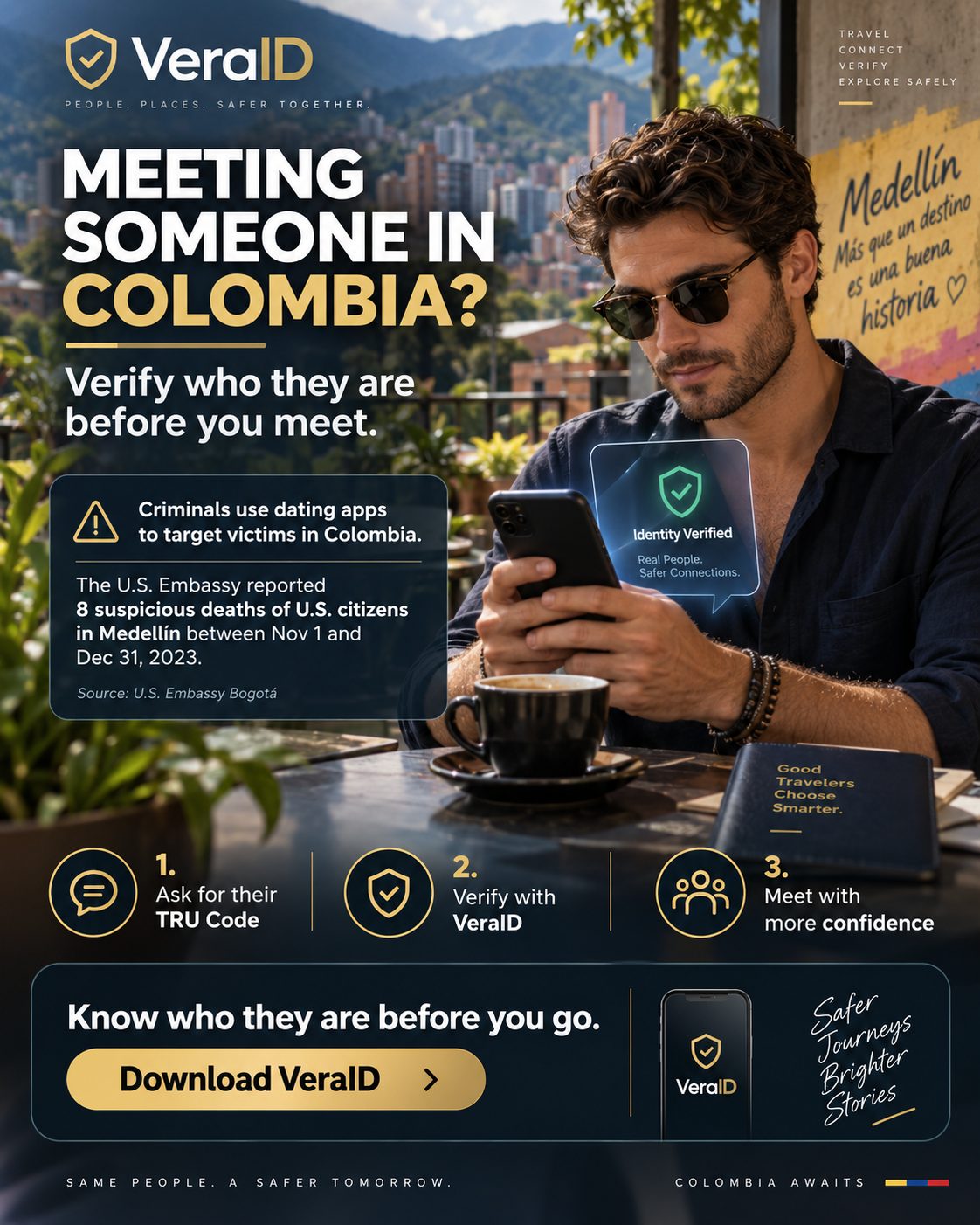
If you’re traveling, close the loop with a voluntary identity check. Tools in this space split into identity verification like VeraID, panic-button apps like Noonlight and UrSafe, and family trackers like Life360. With VeraID, the person you’re meeting verifies their government ID with a biometric check and gets a permanent TRU ID; you look it up and see their photo and verification status. Its honest limitation: it confirms who that one person is, not anyone else you meet that night. Visitor plans cost $5.99, $14.99 or $19.99. Do the lookup before you leave your accommodation, share the plan with someone back home, and treat a mismatch between the verified photo and the person in front of you as your exit cue.
When should you ask for a video call to verify identity?
Ask before emotional or financial investment: after a few days of chatting but before you book the date, send money, or share anything intimate. A match is not a verification, and photos prove nothing. A short video call confirms the person matches their profile, or exposes the gap immediately.
The escalation script
Keep it light and non-accusatory:
“I’m having a great time chatting, but I’m visiting and don’t know many people here. Before we meet, would you be up for a quick video call? Just two minutes, so we both know the other one is real.”
Offer reciprocity: “Happy to do the same on my end.” A real person rarely objects to a two-minute call framed as mutual.
Reading the response
One postponement with a concrete reschedule is normal. A pattern is the signal: repeated excuses, a camera that’s “broken,” calls that cut off before their face appears, or anger at a reasonable request. Someone who refuses verification while pushing to meet quickly, move to another platform, or involve money is telling you to stop engaging and walk away.
What should you do after confirming you’re talking to a catfish?
Stop contact first, then report. Do not announce that you figured them out; a heads-up just gives them time to delete evidence or reuse your photos for new fake profiles.
If you have not sent money or documents
Block the account and report it inside the app, then check whether your photos were reused. Run your own pictures through TinEye’s reverse image search to see if they appear on other profiles, and reverse-search the photos they sent you if you have not already. If you connected on WhatsApp or Telegram, report and block there too.
If you already have
If you sent money, contact your bank or card issuer immediately and ask about a fraud claim or recall; speed matters more than certainty. If you shared passport scans, ID photos, or financial details, file a report with the FTC at ReportFraud.ftc.gov (US) or Action Fraud (UK), and monitor your accounts. If they threaten to release your photos or conversations, do not pay; save the messages as evidence and report the account.
Do free dating apps and their verification badges protect you?
A free app’s own verification confirms one narrow thing: the person uploaded a selfie or document at some point. It does not confirm the profile you’re messaging belongs to that verified person, and a match is not a verification. Stolen photos plus a borrowed verified account is a common catfish setup.
What in-app badges actually confirm
A badge says the platform checked an identity once. It says nothing about who is typing to you today, whether the photos are current, or whether the account was sold or shared. Treat any badge as a data point, not a conclusion.
Where third-party verification fits, and where it falls short
VeraID lets you check the specific person you’re about to meet, before you go, with visitor plans at $5.99, $14.99 and $19.99. That closes the gap a badge can’t: you confirm the individual behind a permanent TRU ID, not just some account. Its limits are real: it verifies identity at a moment in time, it only works if the other person has registered and verified, and it is voluntary, so a refusal tells you something but the absence of a check tells you less.
FAQ
Do reverse image searches work if the catfish uses AI-generated photos?
Partially. AI-generated faces usually return no matches, since the image has never been posted anywhere. That silence is itself a signal: a real person’s photos almost always leave traces. Watch for AI tells like warped ears, teeth, or backgrounds, and lean harder on video calls, which a still image cannot survive.
What if they refuse a video call but keep chatting warmly?
Treat the refusal as the answer. Warmth costs a catfish nothing; a live call exposes them. One postponement with a concrete reschedule is forgivable. A pattern of broken cameras, calls that cut off before their face appears, or anger at a reasonable request means stop engaging and block the account.
Is it rude to ask someone to verify before meeting?
No, if you frame it as mutual. Say you’re visiting and don’t know many people, ask for a two-minute video call, and offer to do the same on your end. A real person rarely objects to reciprocity. Someone pushing to skip checks while rushing to meet is telling you something.
Does a verification badge on a dating app mean the profile is safe?
No. A badge confirms the platform checked an identity once, not that the person messaging you is that person. Stolen photos paired with a borrowed verified account is a common setup. Treat the badge as one data point, then run your own checks: reverse image search, detail cross-checks, and a live video call.
Verify before you meet
Look up a provider's TRU ID and see their photo and verification status in seconds.